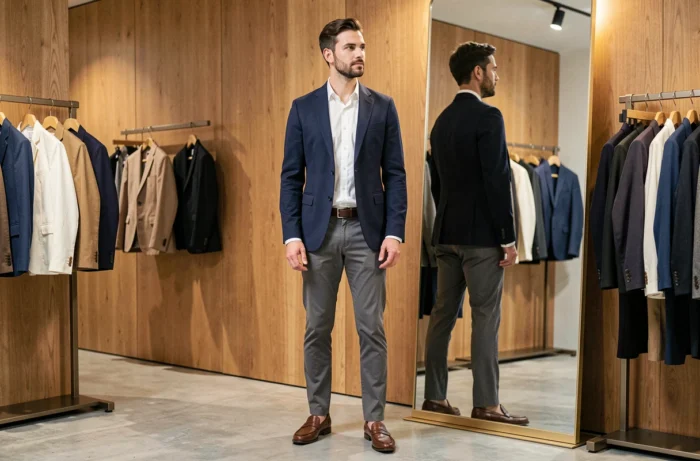
The men’s clothing market is undergoing a transformation that classic style guides rarely incorporate. Tailoring is making a comeback, but in a more relaxed form, far from the fitted suits of the 2010s. Color palettes are shifting towards mineral tones (brown, deep greens, earthy shades). Choosing men’s clothing is no longer just about assembling pieces: it’s also about understanding the context in which these pieces are produced and sold.
A European directive will prohibit large companies from destroying unsold clothing and shoes starting July 19, 2026.
Relaxed tailoring: why men’s suits are changing shape
Shirt sales are on the rise in France, driven by a return to formal wear on runways and in everyday wardrobes. The suit is not disappearing; it is evolving. Shoulders are becoming more natural, straight or slightly wide legs are replacing slim cuts, and pleats are making a comeback.
This shift has a direct consequence on the choice of pieces. A man buying a suit in 2026 is no longer looking for the same thing he was five years ago. Relaxed tailoring can be worn from the office to dinner without changing outfits. The jacket is deconstructed, the trousers fall straight, and the ensemble works well with an open shirt or a slim tie.
For those who want to discover men’s articles on Must Paris, this trend translates into pieces designed for versatility rather than single-use.
The key takeaway: a suit with natural shoulders and straight legs fits into more contexts than an ultra-fitted model. However, this cut requires particular attention to the length of the jacket, which should not fall too low to avoid weighing down the silhouette.

Earth tones and natural materials: building a cohesive men’s palette
The fall-winter 2026 trends confirm a shift towards mineral colors. Brown, khaki, deep green, rust: these shades are gradually replacing black and gray as the base of the men’s wardrobe. This change is not purely aesthetic.
Earthy tones are more forgiving of mismatches than black. Brown chinos can be paired with an olive green sweater, an ecru shirt, or a leather blazer without creating dissonance. Black, on the other hand, imposes a strict contrast that complicates combinations for the uninitiated.
Materials to prioritize based on use
- Thick cotton (like oxford or flannel) for mid-season shirts that hold their shape without excessive ironing
- Crumple-resistant wool for casual suits, which accepts light creases without looking neglected
- Soft leather (jacket or accessories) as a strong piece in a casual look, provided that overly shiny finishes that lean towards evening wear are avoided
The choice of material influences appearance as much as a well-chosen cut. A raw denim paired with a textured wool jacket creates a contrast of materials that adds depth without multiplying patterns.
European textile regulation and men’s brand choices
One aspect that most style guides overlook: the regulatory framework in which brands operate directly influences the available offerings. The ban on destroying unsold textiles will come into effect on July 19, 2026 for large companies in the European Union.
This constraint pushes brands to adjust their production volumes and offer more durable pieces designed to stay in the catalog longer. For consumers, this potentially translates to broader access to quality clothing, as brands have an interest in producing pieces that sell over time rather than disposable collections renewed every month.
Field reports vary on this point: some brands absorb the constraint by reducing the number of references, while others increase unit prices. Choosing a brand whose model is based on sustainable basics rather than rapid turnover becomes a key selection criterion.
Men’s accessories and shoes: the mistakes that sabotage a look
Accessories do not save a poorly constructed outfit, but they can ruin a good one. The most common pitfall is accumulating strong elements (patterned tie, oversized watch, flashy belt buckle) on an already busy base.
Shoes: the most visible point of coherence
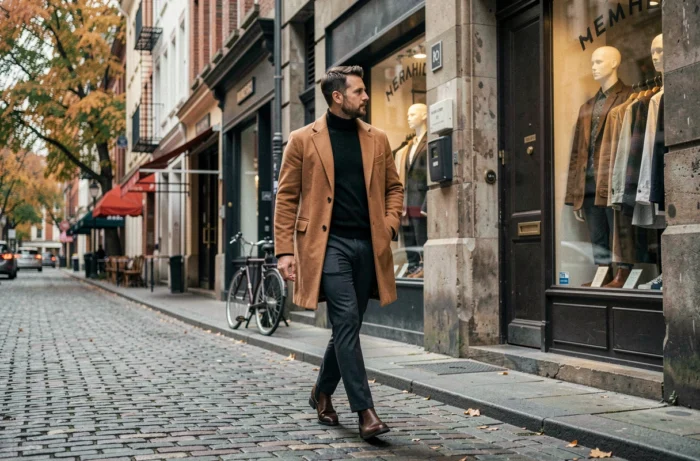
A pair of smooth leather shoes works with chinos and a shirt, but looks out of place under raw denim worn with a t-shirt. In contrast, minimalist sneakers transition from casual to smart casual effortlessly.
- One pair of round-toed leather shoes covers most formal and semi-formal situations
- White or grained leather sneakers complete the casual wardrobe without forcing contrast
- Thin-soled ankle boots (like Chelsea) ensure the transition between the two registers, especially in fall-winter
Coherence between shoes and trousers determines the credibility of an outfit. Trousers that are too short on a bulky shoe create a disproportionate imbalance that neither the jacket nor the accessories can correct.
Patterns and ties: the rule of the single element
One strong pattern per outfit is sufficient. A striped shirt is worn with a solid suit. A patterned tie requires a sober shirt. Mixing two patterns of the same scale (fine stripes on fine stripes) produces an unpleasant visual vibration effect. A strong pattern works when everything else is calm.
Men’s dressing style is built less by accumulation than by subtraction. Durable pieces, cuts that transcend contexts, colors that pair effortlessly: these silent choices create a functional wardrobe. The next time you hesitate between two garments, the useful question is not which is trendier, but which will go with the most pieces you already own.