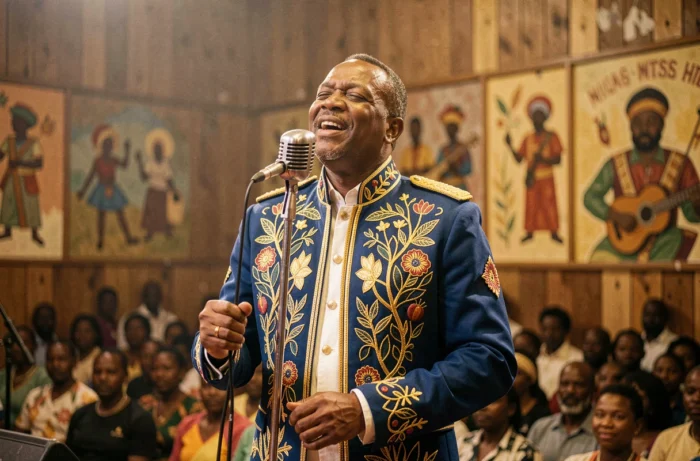
Jules Shungu Wembadio Pene Kikumba, known as Papa Wemba, did not simply sing Congolese rumba: he redefined its vocal grammar and stage codes over four decades. His tenor range, his modulations borrowed from Luba funeral songs, and his ability to overlay melodic lines on sebene patterns remain technical markers that the post-Viva la Musica generation struggles to reproduce.
Papa Wemba’s Vocal Range and Technique: What Rumba Owes to a Luba Tenor
Papa Wemba’s voice was distinguished by an extended range and a systematic use of controlled falsetto, a rare characteristic in rumba where singers favor the chest register. His phrasing incorporated tonal inflections inherited from the ceremonial songs of the Sankuru region, his native land (Lubefu).
This technique allowed him to transition from a low, almost spoken register to high soaring notes without audible breaks. Papa Wemba’s falsetto served as a harmonic signature, immediately identifiable from the first measures of a song. We observe that this approach has influenced vocalists like Koffi Olomidé and Fally Ipupa, who have incorporated fragments of this phrasing into their own productions.
The sound archive available on papawemba.fr allows us to trace this vocal evolution, from the early recordings with Zaïko Langa Langa to the solo albums of the 2000s.
Viva la Musica: Laboratory of Modern Rumba in Kinshasa
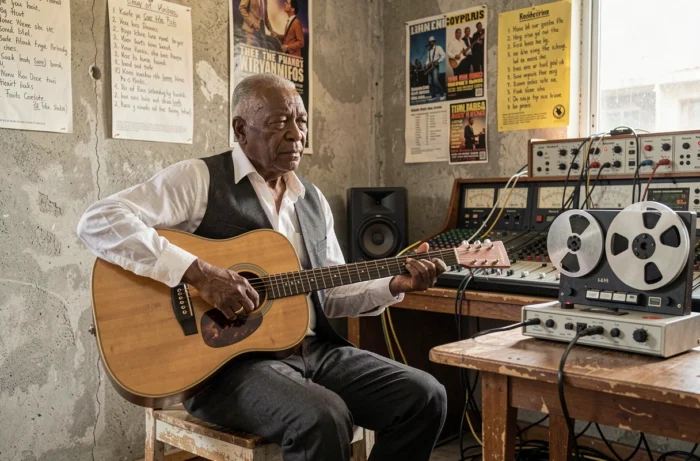
Viva la Musica, founded by Papa Wemba, was not just an orchestra. It was a training workshop where future headliners of Congolese music were made. The group operated on a rotation principle: musicians would come in, learn a discipline of collective playing, and then leave to form their own bands.
Viva la Musica trained the majority of Congolese stars of the 1980s and 1990s. This “nursery” model remains unique in African music. While other orchestras sought stability in their line-up, Papa Wemba embraced constant renewal as a creative engine.
Musically, the orchestra introduced several innovations into Kinshasa rumba:
- The integration of synthesizers and drum machines from the mid-1980s, at a time when rumba remained very acoustic in its basic instrumentation
- A focus on vocal arrangements in polyphony, with structured choruses in counterpoint rather than simple responses to the soloist
- An openness to pop and world music sounds that led to Papa Wemba’s international collaborations, notably with European producers
This hybridization did not dilute rumba. It equipped it to circulate outside the continent without losing its Congolese rhythmic roots.
Papa Wemba and Sape: A Fashion Heritage Turned Museum Object
Sape (Société des Ambianceurs et des Personnes Élégantes) existed before Papa Wemba, but he transformed it into an international media phenomenon. His role was not limited to wearing designer clothes: he codified Sape as a philosophy of self-presentation, with precise rules on color combinations, hat-wearing, and walking style.
The heritage of this legacy is taking concrete form. Papa Wemba’s flamboyant wardrobe is now displayed in the house-museum in Kinshasa dedicated to his memory. His clothes are treated as museum objects in their own right, alongside his instruments and records.
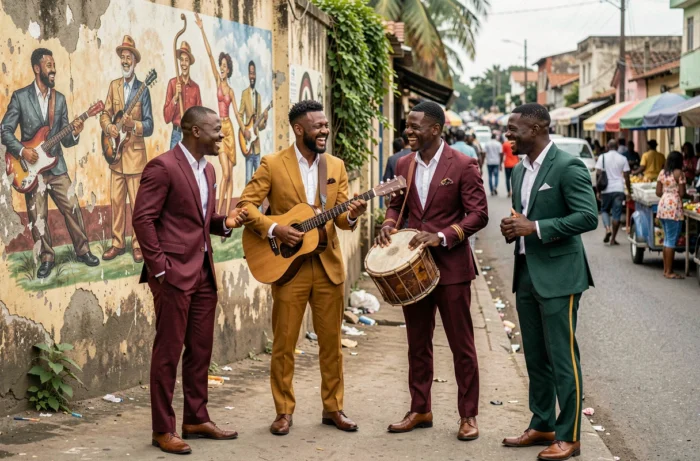
This visual dimension continues to inspire contemporary creation. The Vlisco brand, on the occasion of its anniversary in 2026, has drawn on Papa Wemba’s fashion imagery in a campaign that intersects textile heritage and Congolese urban culture. Papa Wemba’s influence on African fashion extends beyond the musical realm.
Congolese Rumba: A Recognized Heritage but Threatened by Oblivion
Congolese rumba enjoys international recognition, but this visibility is not enough to ensure its transmission. Officials from the museum dedicated to Papa Wemba in Kinshasa report that rumba is at risk of disappearing from public memory, despite regular tributes.
The problem is structural. There is no conservatory dedicated to rumba in the DRC, no national program for teaching its instrumental and vocal codes. Young Kinshasa musicians are turning to Nigerian afrobeats or Ivorian coupé-décalé, genres perceived as more profitable on streaming platforms.
The museum located in Papa Wemba’s former home organizes visits, conferences, and concerts, but its attendance remains very low. This memorial site, although active, illustrates the gap between the symbolic recognition of an artist and a country’s ability to transform that legacy into sustainable cultural infrastructure.
- Absence of a comprehensive digitized catalog of classic rumba recordings
- Low institutional support for orchestras that perpetuate the traditional repertoire
- Competition from English-language music genres on streaming platforms in Central Africa
The question is not whether Papa Wemba deserves tributes. It concerns the ability to convert his posthumous fame into concrete transmission tools: sheet music, restored audio archives, instrumental training. Without this, Congolese rumba risks becoming an object of nostalgia rather than a living genre.
The Molokaï village, a neighborhood in Kinshasa where Papa Wemba established his cultural stronghold, remains a symbol. But a symbol does not replace a heritage policy. It is on this ground, much more than on the commemoration front, that Papa Wemba’s legacy is being played out today.