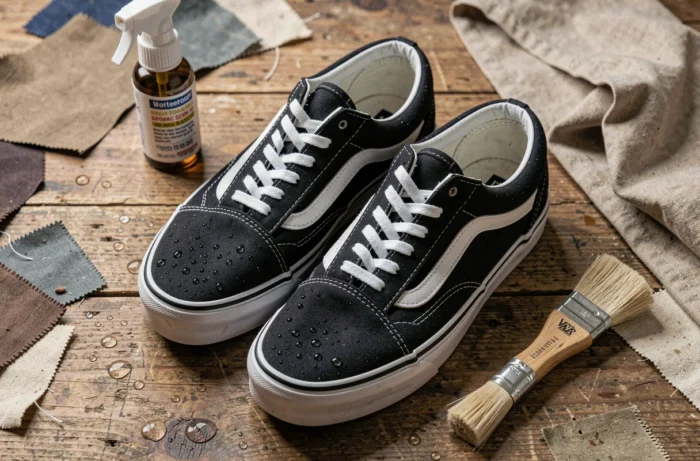
Your Vans Old Skool get wet at the first downpour, and your socks end up soaked before you even arrive at the office. The canvas-suede blend that gives this model its charm is also what makes it permeable. The good news: a few well-chosen actions can create an effective barrier against moisture, without damaging the style or the material.
PFAS Regulation and Waterproofing Sprays: What Has Changed
Before choosing a product, a regulatory point deserves your attention. France now imposes very strict thresholds on PFAS (perfluoroalkyl substances) in shoe waterproofing products: maximum 25 ppb per individual PFAS and 250 ppb for the sum of identified PFAS. For fluorinated polymers in total, the ceiling is set at 50 ppm.
In practical terms, the old ultra-hydrophobic fluorinated sprays that were easily found a few years ago can no longer be marketed in France if they exceed these thresholds. If you still have an old bottle of waterproofing spray in a cupboard, check its composition before using it on your Vans.
This regulatory tightening has accelerated the arrival of PFAS-free solutions on the market: silicones, non-fluorinated polymers, natural waxes. These alternatives work well on the canvas and suede of Old Skool, provided that a precise application protocol is followed. Seeking to waterproof your Vans Old Skool now involves using compliant products that are less aggressive for the material and the environment.

Silicone Spray, Nano-Protection or Wax: Which Waterproofing for Vans Old Skool
Have you ever noticed that two sprays sold side by side in a store can yield radically different results on the same pair? The reason lies in the type of barrier they create.
Silicone Spray
The silicone-based spray deposits a flexible film on the textile fibers. It works well on the canvas of Vans Old Skool because it does not alter the fabric’s flexibility. Silicone beads water on the surface without clogging the pores of the canvas. However, it wears out faster than wax and requires regular reapplication, about every three to four weeks if you frequently wear your Vans in the rain.
Nano-Protection (Non-Fluorinated Polymers)
PFAS-free nano sprays act on a finer scale. They coat each fiber individually, providing more durable hydrophobicity than classic silicone. This type of product also works on suede, the synthetic leather side stripe, and the seams, three areas where water primarily infiltrates on an Old Skool.
Waterproofing Wax
Wax offers the densest protection, but it alters the visual appearance. On light canvas, it can slightly darken the fabric. It is more suitable for black or dark models where this change goes unnoticed. Its advantage: longevity. A careful application lasts several months, even with daily wear.
Preparing Your Vans Old Skool Before Waterproofing
Applying a spray on a dirty pair is like sealing dirt under the protective layer. Any effective waterproofing starts with a thorough cleaning. Here are the steps to follow:
- Remove the laces and insoles to access the entire surface of the canvas and avoid untreated areas
- Brush the canvas and suede dry with a soft brush to dislodge dust embedded in the fibers
- Clean with a mild soap diluted in warm water, gently rubbing with a cloth or a soft-bristled brush
- Rinse with clear water and let air dry, away from any direct heat source (radiator, hairdryer), which could detach the soles or warp the canvas
The pair must be perfectly dry before any application. If any moisture remains in the fabric, the waterproofing product will not penetrate properly and will leave unprotected areas.
Application Technique for Durable Waterproofing on Canvas and Suede
Why do some sprays seem ineffective after just one rain? The problem rarely lies with the product, almost always with the method.
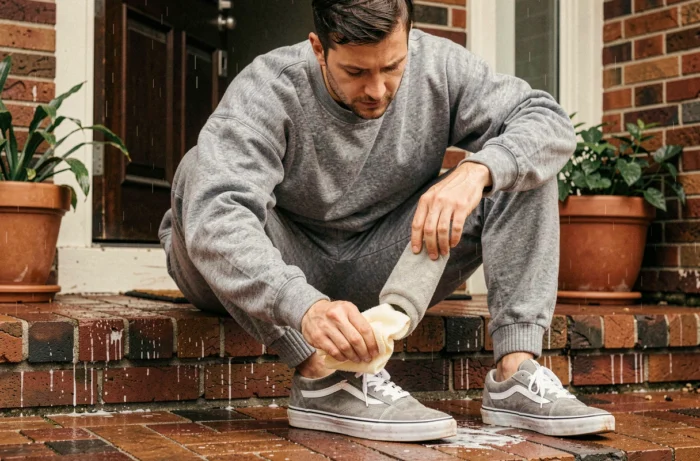
Apply in thin, successive layers rather than a single thick layer. A heavy spray creates drips, saturates some areas, and leaves others exposed. Two to three light passes, allowing five to ten minutes between each layer, ensure an even distribution.
Start with the seams and the canvas-rubber junctions. These are the main entry points for water on an Old Skool. The suede side stripe (the famous “sidestripe”) also deserves special attention: suede absorbs water much faster than canvas.
Treat the laces separately. Soak them in a bath of diluted spray or spray them flat to cover their entire surface. Untreated laces act like wicks that draw moisture into the shoe.
Renewal Frequency
With a silicone or nano spray, plan for a new application every three to four weeks during rainy periods. A simple test allows you to know when to renew: drop a few drops of water on the canvas. If the water beads and rolls off, the protection holds. If it starts to absorb, it’s time to retreat.
For wax, a renewal every two to three months is sufficient in most cases, except for heavy use on wet ground daily.
Limits of Waterproofing on Vans Old Skool
No treatment turns a pair of Vans into rain boots. The canvas will always be less waterproof than a technical membrane like Gore-Tex. Walking in a deep puddle or under prolonged rain will eventually allow water to seep through, even on a freshly treated pair.
The realistic goal: protect your Vans from moderate rain and occasional splashes. For harsher weather conditions, another pair remains the most reasonable choice. Waterproofing also protects the canvas and suede from stains, which extends the lifespan of the pair beyond just the issue of water.
Finally, remember to store your Old Skool with newspaper shoe trees after a wet outing. Residual moisture trapped inside promotes bad odors and premature degradation of the insole, even if the outside has been properly treated.