
Auriculotherapy refers to the stimulation of specific areas of the outer ear for therapeutic purposes. When applied to weight loss, this technique targets points related to appetite, stress, and digestive metabolism. Recent scientific syntheses place its effectiveness within a specific framework: it works as a complement to a comprehensive approach, not as an isolated method.
Biological mechanisms of auricular stimulation
The outer ear has a particular density of nerve endings, notably via the vagus nerve. Stimulation of certain areas activates measurable neurovegetative responses: modulation of ghrelin secretion (the hunger hormone), regulation of cortisol related to food stress, and improvement of digestive transit.
Recent research is gradually moving away from the sole notion of “appetite suppressant” to focus on these measurable biomarkers after stimulation. Publications from 2026 particularly track hormonal variations and inflammatory markers in treated patients, providing a more rigorous framework for evaluating the method.
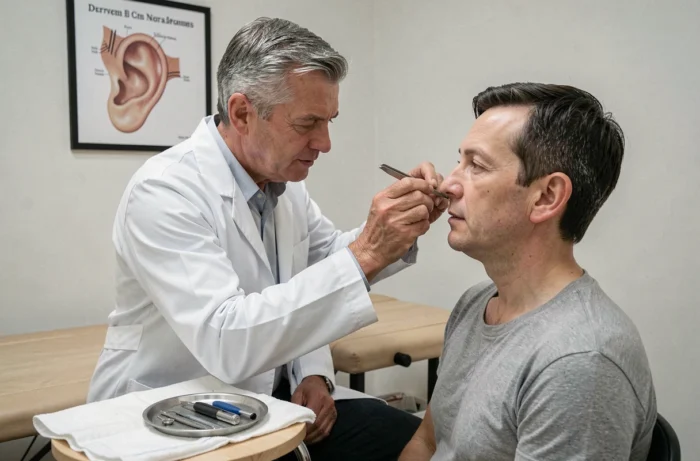
In practice, the practitioner identifies auricular points using a skin electrical resistance detector, then stimulates them with semi-permanent micro-needles, low-frequency laser, or vaccaria seeds held in place by an adhesive. The choice of stimulation mode depends on the protocol and the patient’s sensitivity.
Among the devices used in auricular stimulation for weight loss, the orimag presented by Résolution Santé is based on the principle of a magnet positioned on targeted points of the outer ear, allowing for continuous stimulation between sessions.
Auriculotherapy and weight loss: what combined protocols say
One point is consistent across all recent evidence syntheses: auriculotherapy alone is not sufficient to produce sustainable weight loss. Protocols that achieve the best results combine auricular stimulation with structured dietary support and behavioral follow-up.
This data changes the interpretation of the method. Websites presenting auriculotherapy as a standalone solution miss the clinical reality. The level of evidence has been reassessed upwards for combined protocols but remains insufficient to validate auricular stimulation used alone.
In practice, a typical program looks like this:
- An initial assessment with a trained practitioner, including the identification of auricular points suited to the patient’s metabolic and emotional profile
- Stimulation sessions spaced a few weeks apart, adjusted according to individual response (reduction of compulsions, weight evolution, sleep quality)
- A parallel dietary follow-up, often provided by a nutritionist or naturopath, to structure eating without restrictive dieting
- A behavioral component targeting stress management and emotional eating, factors often crucial in weight regain
This integrated framework explains why some patients report significant results while others observe nothing: the quality of overall support makes the difference.
Targeted auricular points for weight management
Not all points on the outer ear are mobilized in a weight loss protocol. The practitioner typically selects between three and six points based on the patient’s profile. The most frequently stimulated are the hunger point (located on the tragus), the stomach point, the endocrine point, and the Shen Men point, associated with stress management.
The Shen Men point plays a central role in most protocols. Its stimulation promotes a reduction in anxiety, which indirectly reduces compulsive snacking behaviors. The endocrine point aims to regulate hormonal imbalances that hinder weight loss, particularly in women during the premenopausal period.
The auricular mapping used today derives from the work of French physician Paul Nogier, who formalized the correspondence between areas of the outer ear and organs of the body in the 1950s. This mapping has since been enriched by traditional Chinese medicine, explaining the coexistence of two sometimes different nomenclatures among practitioners.

Choosing an auriculotherapy practitioner: concrete criteria
Training in auriculotherapy is not regulated by a state diploma in France. This means that the level of competence varies significantly from one practitioner to another. A few guidelines can help effectively filter:
- Check that the practitioner has undergone specific training in auricular reflexology (and not just general acupuncture), ideally for several hundred hours
- Prefer a professional who offers a comprehensive initial assessment before placing any needles or magnets, and who incorporates a dietary aspect into their care
- Beware of promises of guaranteed numerical results: no serious practitioner can predict a precise weight loss, as the response depends on multiple individual factors
The number of necessary sessions varies by case. Serious support spans several weeks to a few months, with gradual adjustments of the stimulated points based on the patient’s progress.
Auriculotherapy does not replace medical follow-up or dietary rebalancing. It adds as a complementary lever, acting on dimensions that diet alone does not cover: stress, compulsions, hormonal regulation. It is in this interplay that the method finds its relevance, not in a promise of quick results.