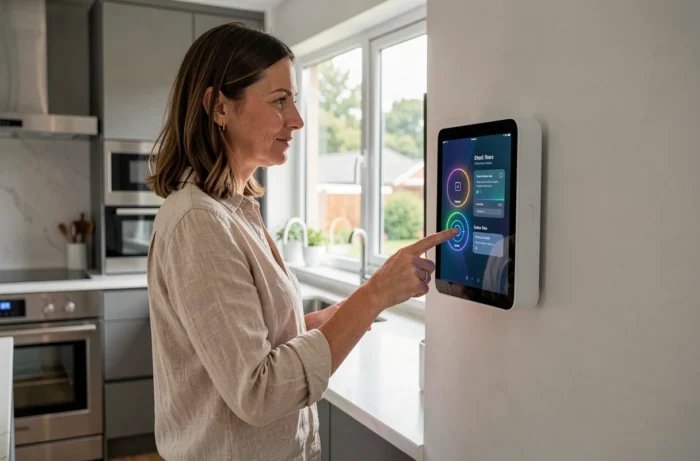
An electric radiator running at full power in an empty room for eight hours is the kind of situation that home automation addresses first. Before talking about gadgets or voice scenarios, smart devices respond to a concrete problem: heating poorly, excessive lighting, and minimal monitoring. Today, connected technology applied to housing is taking on a regulatory dimension that most guides overlook.
Connected thermal regulation and the decree of September 2026
Decree No. 2026-863 of September 12, 2026, sets an environmental performance threshold for any heating, cooling, or hot water production equipment installed in a new building. The transformation coefficient of each energy used must remain below 79 gCO₂/kWh of final energy. Gas exceeds this threshold significantly, marking the end of fossil heating in new constructions starting in 2027.
For homeowners switching to heat pumps or electric heating, connected control is no longer a luxury. A programmable thermostat coupled with communicating thermostatic heads allows compliance with the decree by adjusting the settings room by room, degree by degree.
Decree No. 2023-444 of June 7, 2023, goes in the same direction: it mandates a programmable automatic regulation system room by room with a deadline of January 1, 2027, for new buildings. The catalogs of smart home devices dedicated to connected heating take on real significance here, as we are talking about a legal obligation rather than mere comfort.

Smart devices for security: what really works in daily life
You install a connected camera, receive alerts on your phone, and feel protected. On paper, it’s simple. In practice, reliability depends on three parameters that are often underestimated.
- The quality of the Wi-Fi connection at the exact location where the camera or detector is placed. A load-bearing wall between the router and the sensor is enough to make notifications random.
- Power supply: battery-operated devices lose autonomy in cold weather, especially outdoors. Wired models remain more reliable for continuous monitoring.
- Compatibility between devices from different brands. Without a smart home hub or common protocol (Zigbee, Z-Wave), each device operates in its own app, complicating the centralization of alerts.
Open/close sensors on doors and windows remain among the most useful equipment. They are inexpensive, consume little power, and trigger simple scenarios (notification, siren activation, SMS sending). A well-placed open/close sensor covers a security need without a monthly subscription.
Connected energy management: outlets, lighting, and actual consumption
Connected outlets are the cheapest entry point into home automation. You plug in a device, measure its consumption, and cut off power remotely. It’s basic, but it helps identify actual expense areas.
A dryer plugged into a connected outlet quickly reveals that it consumes as much in standby mode as a washing cycle per week. This kind of concrete data helps make decisions: we automatically cut power at night, we schedule a restart before off-peak hours.
Smart lighting and programmed scenarios
Connected lighting is not just about changing a bulb’s color from your couch. The real gain comes from scheduled programming and presence detectors. A light that automatically turns off after five minutes in an empty hallway is a modest saving per light point, but significant over the entire home throughout the year.
Feedback varies on this point: some users find motion detectors too sensitive (triggered by a passing animal), while others find them too slow to react. Adjusting the sensitivity and the turn-off delay deserves attention during installation.
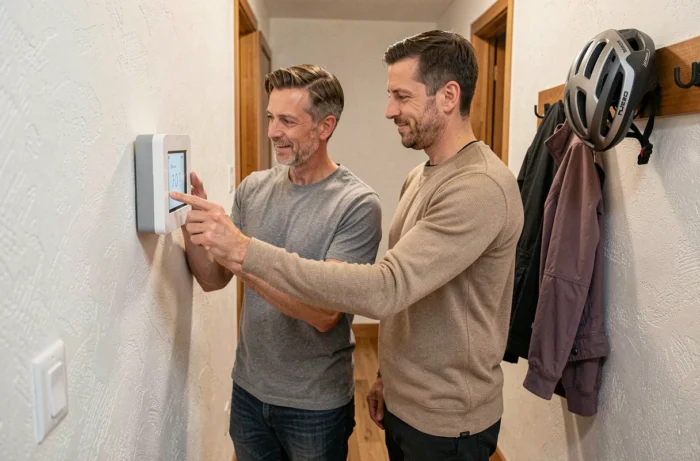
Smart home protocols and compatibility between connected devices
The choice of communication protocol determines what can be evolved in your installation. We distinguish three main families:
- Wi-Fi, which is everywhere but bandwidth-hungry when multiple devices are connected. Beyond about fifteen connected objects, the home network can become saturated.
- Zigbee and Z-Wave, which use a mesh network independent of Wi-Fi. Each device relays the signal to its neighbors, improving range. They require a dedicated hub or coordinator.
- The Matter protocol, which is newer and aims to unify compatibility between manufacturers. It allows devices from different brands to communicate without a third-party app, provided each device is Matter certified.
Before purchasing your first smart device, checking which protocol it uses can prevent ending up with three distinct apps to control five devices. The smart home hub (Jeedom, Home Assistant, or proprietary solutions from major manufacturers) centralizes commands and scenarios, regardless of each sensor’s protocol.
Think of the installation as a system, not a collection
People often buy a connected thermostat, then a camera, then bulbs, without an overall plan. The result: devices that operate in silos. A useful scenario connects at least two objects together (the open/close sensor turns off the heating when the window opens, the light sensor adjusts the blinds).
It’s this logic of interconnected scenarios that transforms an accumulation of objects into a connected home. Without it, we simply have remote controls on our smartphones.
Thermal regulations are now pushing in this direction: automation and control systems for tertiary buildings are already subject to specific decrees, and residential follows the same trajectory. Investing in compatible smart home devices today is anticipating obligations that will tighten in the coming years.