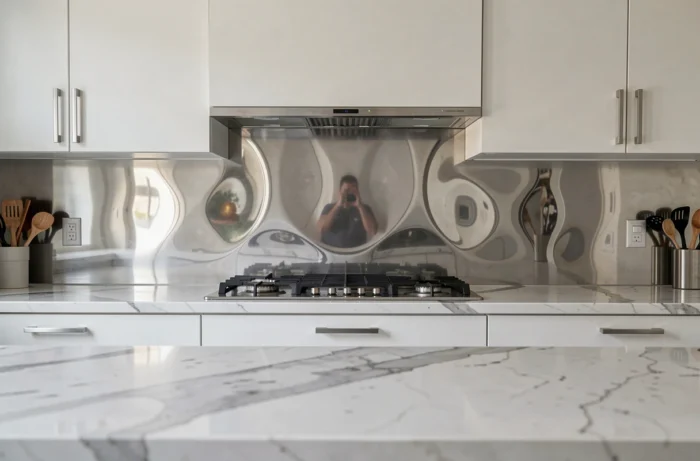
Between the spectacular visual rendering of a perfectly reflective surface and the reality of a material that shows every fingerprint, the mirror stainless steel backsplash occupies a unique place in kitchen design. Understanding what distinguishes this finish from other stainless steel options and measuring the gap between its aesthetic advantages and maintenance constraints allows for an informed choice before ordering a custom piece.
Mirror stainless steel, brushed or satin: a comparative table of finishes
The choice of a stainless steel backsplash is not limited to the metal’s hue. The finish radically alters the surface’s behavior on a daily basis. Here is a comparison of the three main options offered by manufacturers.
| Criterion | Mirror stainless steel (polished) | Brushed stainless steel | Satin stainless steel |
|---|---|---|---|
| Visual aspect | Sharp reflection, spectacular effect | Directional lines, industrial look | Velvety matte, understated rendering |
| Visibility of fingerprints | Very high | Moderate | Low |
| Visibility of micro-scratches | Very high | Low (masked by brushing) | Low |
| Brightness sensation | Maximum (total reflection) | Medium | Medium to low |
| Recommended cleaning frequency | Daily | Weekly | Weekly |
| Decor compatibility | Contemporary, minimalist | Industrial, Scandinavian | All styles |
This table highlights a clear gap between mirror stainless steel and the other two finishes regarding maintenance. Several recent kitchen guides describe the polished mirror finish as a “spectacular but demanding” option, while brushed and satin finishes are considered easier compromises to live with.
Choosing a custom mirror stainless steel backsplash thus prioritizes decorative impact, accepting a stricter maintenance discipline than with textured finishes.
Fingerprints and micro-scratches: what mirror stainless steel really demands
Fingerprints and micro-scratches are very visible on polished mirror stainless steel, much more so than on any other metallic finish. This point is the main source of frustration reported by users.
The perfectly smooth surface acts as an amplifier: the slightest greasy fingerprint captures light and becomes immediately noticeable. In a kitchen where oil, butter, or sauces are handled, this means marks after every meal preparation.
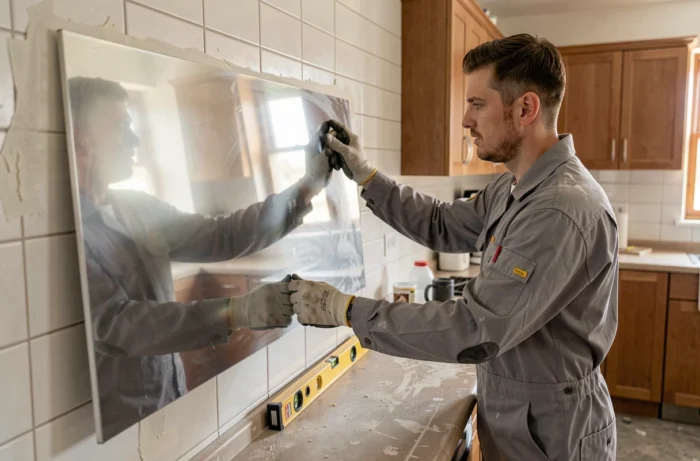
Feedback collected from several sources indicates that a specific action, consisting of wiping in the direction of the grain with an appropriate product, significantly reduces frustration related to marks. The condition: accept a gradual patina rather than a permanent new appearance.
As for micro-scratches, the reality is simple. Any mirror surface will eventually accumulate them, and no surface treatment can prevent them indefinitely. In contrast, on brushed stainless steel, these same scratches blend into the directional pattern and remain invisible to the naked eye.
Maintenance protocol suitable for mirror finish
- Wipe daily with a damp microfiber cloth in one direction, never in circular motions, to avoid creating halos
- Use a specific stainless steel cleaning product (no scouring cream, no abrasive sponge) to preserve the polish
- Periodically apply a food-grade protective oil that forms an invisible film and reduces the adherence of fingerprints
This protocol transforms maintenance from a chore into a quick routine, provided it is adhered to.
Custom mirror stainless steel backsplash: technical parameters to check
Ordering a custom backsplash is not just about providing measurements. Several technical parameters directly influence the final result and the durability of the installation.
The thickness of the sheet determines the rigidity and flatness of the surface. A sheet that is too thin warps due to the heat emitted by a cooking surface, distorting reflections and ruining the desired mirror effect. Specialized manufacturers generally recommend a sufficient thickness to ensure mechanical stability without thermal deformation.
Custom cuts and adjustments
Seamless backsplashes, made from a single continuous piece, are one of the main arguments in favor of stainless steel over traditional tiling. The absence of joints facilitates cleaning and improves hygiene, as no cracks can accumulate food residues or mold.
Cuts for electrical outlets, switches, or non-standard angles should be made in the factory, not on-site. An approximate cut on polished mirror stainless steel leaves visible burrs that manual polishing cannot correct properly.
- Measurement taken to the millimeter, including any irregularities in old walls
- Exact positioning of outlets and switches with defined tolerances before manufacturing
- Choice of fixing type (structural adhesive or invisible mechanical fixing) depending on the wall support
- Verification of wall flatness, as any irregularity literally reflects in the mirror surface
Mirror stainless steel versus lacquered glass and laminate: which material for which use
Mirror stainless steel is not the only material capable of producing a luminous and contemporary effect in a backsplash. Satin or lacquered glass and some matte mineral laminates are regularly cited as alternatives in recent guides.
Lacquered glass absorbs light without showing as many fingerprints, while remaining compatible with seamless backsplashes. It offers a warm rendering and a very wide color palette. However, it is less resistant to impact than a stainless steel sheet, which is inherently unbreakable.
Matte mineral laminates represent an intermediate option: they do not reflect light like the mirror, but their maintenance is minimal and their thermal resistance suits most cooking configurations.
Mirror stainless steel is fully justified in a space where natural light is low, as its total reflection capacity amplifies every light source and creates an illusion of enlargement. In a kitchen that is already very bright or facing south, this advantage loses its weight, and a material that is less demanding in maintenance may prove to be more prudent.
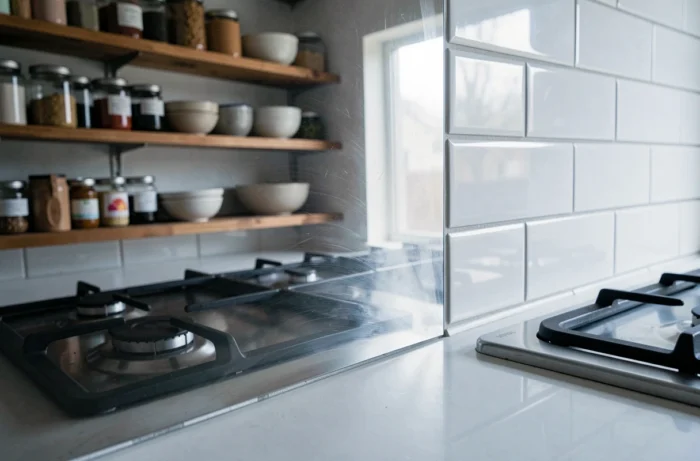
The choice between these materials ultimately rests on a trade-off between visual impact and maintenance tolerance. Mirror stainless steel produces the most striking effect, provided that the cleaning discipline it imposes is integrated from the start. For those seeking the perfect reflection without aesthetic compromise, it is a material that lives up to its promises, as long as one keeps theirs in return.