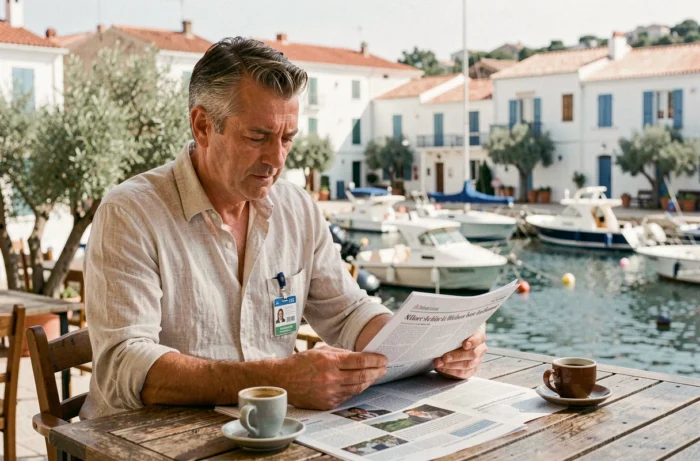
Every morning, millions of people open an app or turn on their set to find out what is happening around the Mediterranean. Migration conflicts, warming waters, geopolitical tensions, cultural festivals: Mediterranean news covers a wide spectrum, where topics intersect and influence each other. Understanding this area means following a thread of information that intertwines politics, environment, and culture, often in real-time.
Marine heatwaves in the Mediterranean: a changing thermal regime
Have you noticed that the water temperature on vacation seems to be a bit higher each year? This feeling corresponds to a measured reality. Data from the Copernicus service for summer 2026 shows that the western Mediterranean (Gulf of Lion, Balearics, Tyrrhenian Sea) is recording anomalies of +5 to +6 °C above reference averages, with occasional peaks at +8 °C compared to the period 1991-2020.
This is no longer an isolated episode. Copernicus and ESA report that 98% of the Mediterranean basin was affected by marine heatwaves in the first half of 2026, with about 80% subjected to strong to extreme conditions. Marine heatwaves in the western Mediterranean exceed an average of 85 consecutive days in 2026, compared to less than 50 days in 2019.
This structural change does not only concern scientists. Artisanal fishing, ports, beach resorts, and coastal infrastructure must adapt to a sustainably modified thermal regime. This is the type of information that mainstream media treats as a brief, whereas it deserves continuous follow-up with in-depth analyses.
Several online newsrooms provide regular coverage of these Mediterranean topics, as can be seen on https://www.euromediatelevision.fr/, which centralizes reports and analyses on the area.
Migratory routes in the Mediterranean: the figures for 2026
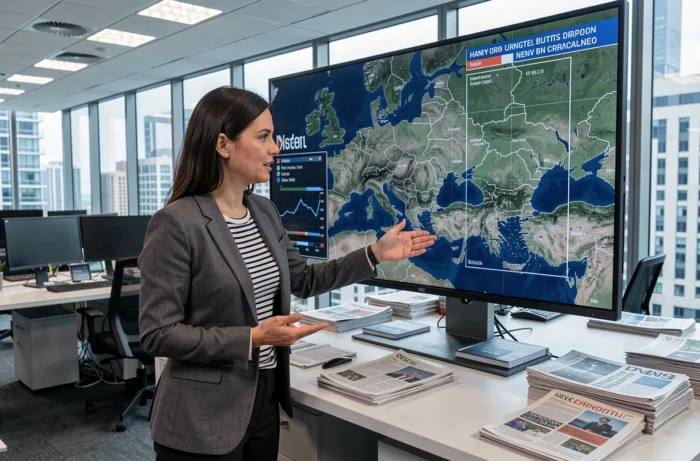
The other ongoing news thread in the Mediterranean concerns migration flows. Data from IOM (International Organization for Migration) for the first half of 2026 reveals a contrasting evolution depending on the routes.
- The central Mediterranean route (Libya and Tunisia to Italy) remains the deadliest, with an increase in deaths and disappearances compared to the same period in 2025.
- Frontex reports a decrease in irregular crossings at EU borders, but this trend masks redistributions of flows to new routes, particularly land routes.
These raw data do not speak for themselves. The work of Mediterranean newsrooms consists of contextualizing them: explaining why one corridor closes when another opens, documenting crossing conditions, and giving voice to NGOs like SOS Mediterranee and authorities.
Why continuous follow-up changes understanding
A one-off report on a shipwreck informs. Continuous follow-up allows for spotting trends: the seasonality of departures, the impact of bilateral agreements, the changing tactics of smugglers. It’s the difference between a news item and a structured analysis.
Politics and geopolitics around the Mediterranean
The Mediterranean is not just a natural or humanitarian space. It is a dense political theater. Reconstruction of Syria, tensions in Libya, relations between the European Union and Maghreb countries, France’s foreign policy in North Africa: each week brings its share of developments.
Why are these topics often treated in a fragmented way? Because national newsrooms cover the angle that concerns their country. A media outlet focused on the Mediterranean area can, on the contrary, cross perspectives between the northern and southern shores, which major mainstream media rarely do in their daily coverage.
Emmanuel Macron’s visit to Syria, documented by France 24, illustrates this intertwining: reconstruction of a country, economic markets to seize, regional diplomatic stakes. The same event touches on French foreign policy, the Levant’s economy, and the security balances of the entire Eastern Mediterranean.
Culture and magazine info: the other side of Mediterranean news
Mediterranean news is not limited to crises. Film festivals, culinary heritage, musical creation, sustainable tourism: the area produces rich cultural news, often underreported by national media that prefer summer news items.
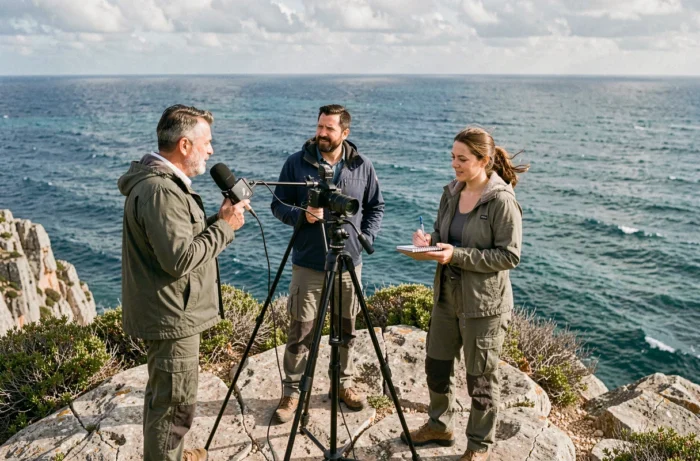
A media outlet that covers the Mediterranean continuously can dedicate an audio report to a Corsican festival, a video analysis to the evolution of tourism in Tunisia, a magazine on Greek vineyards. These long formats, straddling news and documentary, attract an audience curious about the cultural diversity of the basin.
The role of video and audio formats
Video and audio have become the dominant formats for online information. A filmed report on the Spanish coastline threatened by erosion conveys a reality that text alone cannot capture. Podcasts allow for a deeper exploration of a topic over twenty or thirty minutes, where a written article is limited to a few hundred words.
Mediterranean information benefits from being multi-format: text for analysis, video for fieldwork, audio for perspective. Newsrooms that combine these three media offer more comprehensive coverage.
Reading Mediterranean news with a critical eye
In the face of the mass of available information, how can one distinguish a reliable analysis from a mere relay of a dispatch? Here are some concrete guidelines:
- Check if the article cites its sources (Copernicus report, IOM data, official statement) or merely makes vague assertions.
- Observe if the media offers follow-up over time, not just a hot reaction.
- Look to see if the covered topics go beyond mere news items to include in-depth analyses on the environment, politics, or culture.
The Mediterranean concentrates issues that directly affect France, Europe, and North Africa. Following this news with specialized sources does not replace mainstream media but complements them within a specific geographical scope. A basin of 500 million inhabitants, twenty-two bordering countries, three continents: the subject deserves more than a secondary section.