
On a a construction site, when taking a plastic column out of the truck, the first thing we look at is not the manufacturer’s label. It’s the color of the tube, the printed stripes along its length, and the few letters molded into the wall. These marks condense everything you need to know before installation: material, permitted use, allowable pressure, and compliance standard. Misreading them can lead to costly, even dangerous, mistakes.
Color of the plastic column: the first sign to interpret
Even before reading anything, the hue of the tube gives an immediate indication of its intended network. There are widely shared technical conventions among manufacturers and installers.
- Blue: drinking water supply network. This is the most standardized color. A blue HDPE tube is almost always intended for pressurized water.
- Black with yellow or orange stripe(s): gas distribution. The colored stripe on a black background indicates gas use, including on buried columns.
- Orange: protection for telecom cables or fiber optics. It is often found in corrugated sheathing but also in smooth tubes.
- Gray: rigid PVC electrical conduits, used both indoors and outdoors under slabs.
- Green: sewers, wastewater, or drainage. Green columns are found in non-collective sanitation or gravity drainage.
These conventions do not replace reading the inscriptions, but they allow for quick sorting of stock or spotting a delivery error. When you need to recognize the signs on a plastic column, color remains the most reliable starting filter on site.
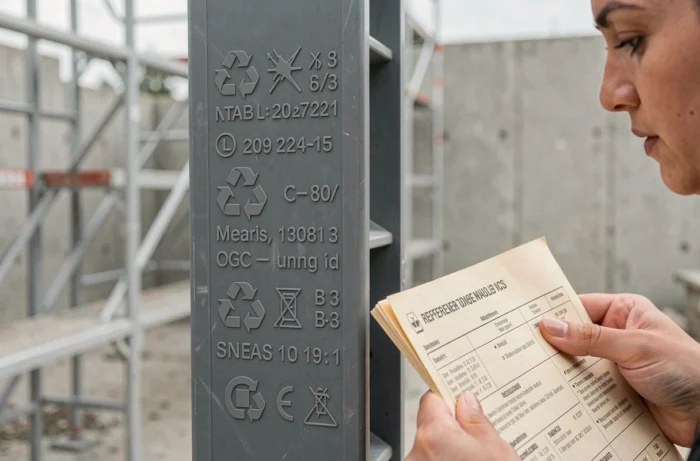
Letters and numbers molded on a PVC or HDPE column
The printed or engraved inscriptions along the tube follow a logical order. They usually include the material symbol, nominal diameter, nominal pressure, and standard reference. Each element has a specific role.
Plastic material symbol
The letters identify the resin used. On a drainage column, you often read PVC (polyvinyl chloride). On a buried water network, you find HDPE (high-density polyethylene) or sometimes PE100, which specifies the resistance grade of the polyethylene. For heating or hot water installations, PPR (random polypropylene) frequently appears.
These symbols are not decorative. A PPR tube installed on a buried cold water network will not meet the same mechanical constraints as an HDPE. Confusing the two risks premature breakage.
Diameter and wall thickness
For example, you read “110 x 3.2”. The first number corresponds to the outer diameter in millimeters, the second to the wall thickness. This pair of values determines the pressure class of the tube and its connection with fittings (elbows, tees, couplings).
On some columns, only the DN (nominal diameter) appears, without thickness. In this case, you need to refer to the standard indicated further down the marking to find the complete specifications.
Nominal pressure (PN) and stiffness class (SN)
The mention PN followed by a number indicates the maximum service pressure in bars. On gravity columns (drainage, rainwater), you will find the stiffness class SN, which measures crush resistance. Not checking the PN before connection is the most common mistake on mixed sites where pressure tubes and drainage tubes coexist.
Standards and compliance markings on plastic tubes
After the material and dimensions, the marking line contains one or more standard references. These mentions confirm that the tube was manufactured according to a specific specification and tested accordingly.
On a PVC drainage tube, for example, you read the corresponding European standard reference. On a potable water HDPE, the standard will be different and sometimes accompanied by a logo or a health approval number. The presence of the standard on the tube is the only verifiable guarantee on site that the product is compliant with the intended use.
Color stripes and traceability lines
In addition to textual inscriptions, some columns have longitudinal colored stripes. On HDPE tubes, a blue stripe indicates potable water use, while a yellow or orange stripe refers to gas. These stripes are co-extruded with the tube (they do not fade) and allow for quick identification even when the printed marking is partially covered in dirt or worn.
Some manufacturers add complementary traceability markings: batch number, production date, extrusion speed. These data are mainly used in case of disputes or product recalls, but they also confirm that you are dealing with a controlled manufacturing tube.

Recycling symbols on plastic columns: what they really indicate
The triangle formed by three arrows (Möbius circle) with a number in the center also appears on plastic columns and pipes. This symbol identifies the resin family, not the tube’s destination. The number 3 corresponds to PVC, 2 to HDPE, and 5 to polypropylene.
This marking says nothing about the allowable pressure or suitability for food contact. It is sometimes confused with a usage certification, while it is only meant to guide sorting at the end of the product’s life. In the field, it does not provide operational information for the installer.
Feedback varies on this point, but in practice, many professionals ignore this symbol in favor of the detailed technical inscriptions mentioned above. This is logical: between a triangle with the number 3 and the mention “PVC-U PN16” followed by a standard, the latter marking is much more useful for deciding if the tube is suitable for the relevant network.
Quick method to read the signs on a plastic column
On site, there is not always time to analyze each inscription. A three-step reading is sufficient in most cases.
- Check the color of the tube and the possible presence of longitudinal stripes to confirm the network (water, gas, telecom, drainage).
- Read the material symbol and the nominal pressure (or SN class) to ensure that the column meets the project’s specifications.
- Check the printed standard reference, especially on pressure networks or those in contact with potable water.
These three checks take less than a minute and prevent the most common installation errors. The rest of the inscriptions (batch, date, traceability) only concern quality tracking upstream.
A tube with illegible or absent markings should not be installed. The absence of visible signs on a plastic column is in itself information: it signals a dubious product, an outdated stock, or a manufacturing defect. It is better to discard the piece than to discover the problem after backfilling.